

The war waged by the US and Israel against Iran is proving—at least in these first 12 days—to clearly not be going as planned. While Trump speaks of success, the destruction of Iranian missile power, and a swift end to the war, it is evident that none of this is true, or at least not as he describes it. A characteristic example is the fake news spread by American Energy Secretary Chris Wright, who claimed the US Navy was escorting tankers through the Strait of Hormuz, a statement the White House was forced to immediately retract. This reflects an image of a US administration not only in confusion but in weakness and panic—a sentiment echoed by many American media outlets, which emphasize daily that the US made significant miscalculations, underestimated Iran's strength, and ignored the consequences military operations would have on the global energy market and the economy. Increasingly, experts estimate that a US victory over Iran is becoming more unlikely by the day.
Iran sets the terms
Iran is ready for negotiations with the US only if "real security guarantees" are provided, according to a source for the Al Mayadeen television channel. "Iran rejects every mediation initiative for a ceasefire because it has its own terms and demands genuine guarantees," the report highlights. According to the source, Tehran would only return to dialogue with Washington if the US guarantees it will not attack Iran in the future and recognizes the country's right to a full nuclear cycle.
No trust, no talks
Iranian Foreign Minister Abbas Araghchi stated in an interview with PBS that Iran is not considering new talks with the US due to past experiences. "We have a very bitter experience with the Americans. Last year, in June, we negotiated with them and they attacked us during the talks. This year they tried to convince us that everything is different. They promised to solve our nuclear issue peacefully, and we agreed. But after three rounds of negotiations, even when the American team admitted we made great progress, they attacked. That is why I believe talks with the Americans are no longer on the agenda," Araghchi explained.
The plan has failed
He emphasized that the US and Israel expected to change the leadership in Iran "in two to three days," but the plan failed, and now Washington and Tel Aviv "lack clear directives." He also accused both countries of driving up global oil prices and stressed that Tehran's actions are a response to external aggression: "This war was imposed upon us. Our state is being attacked, and we are defending ourselves." According to him, the majority of the population supports the actions of the government and the military: "The people—the majority—are outraged by this aggression. They support our armed forces. Iranian flags are waving everywhere in the streets." Meanwhile, the Islamic Revolutionary Guard Corps (IRGC) announced a new series of attacks on targets in Israel and US bases, using Qadr, Emad, and Kheibar Shekan missiles and drones, marking the 36th phase of the operation.
Trump's demands for surrender
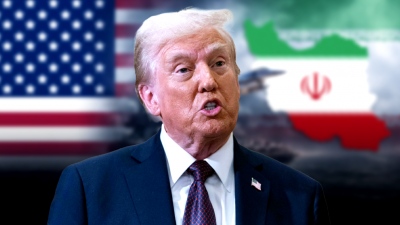
The US President stated that a deal with Tehran is only possible in the event of Iran's total surrender: "There will be no deal with Iran except for unconditional surrender! We, along with our wonderful and courageous allies, will work tirelessly to bring Iran back from the abyss," Trump wrote on Truth Social. The American president added that after surrender or the emergence of a "great and acceptable leader," the US and its allies will help rebuild Iran, with economic improvements and a future "greater, better, and stronger than ever." He continued by explaining to Axios that "unconditional surrender" could mean either a formal declaration or the total loss of military capability: "It can be declared, but it can also happen when they no longer have anything left to fight with."
Victory unlikely
Experts estimate that the US will struggle to achieve a decisive military result: "You cannot achieve a decisive victory in a war with Iran due to its territorial dimensions, military potential, and institutional structure. Now Iran is focusing on showing how harmful this war is for the economy and for Americans. The longer the war of attrition lasts, the more Iran will exploit the situation," said Elli Geranmayeh, an Iran expert at the European Council on Foreign Relations (ECFR). The Wall Street Journal notes that "neither side has yet achieved its strategic goals" and that both sides appear to have "underestimated the other's behavior," leading to a "widening, deadlocked war."
Vietnam scenario
Military historian Yuri Knutov estimates that the US may turn against civilian infrastructure: "The goal is to make the lives of Iranians so difficult that they renounce their government. They will hit factories, bridges, tunnels, the oil and gas industry, and communication networks. The strikes will be catastrophic, not temporary. The Vietnam scenario is repeating on a smaller scale, but without ground troops." Quincy Institute Vice President Trita Parsi also stated that the American administration shows a "sign of lack of strategic direction," as Trump's initial plan failed due to Iran's refusal to cease fire or surrender despite the pressure.
Fake news
The failure of the US is confirmed by the latest moves of the Trump administration. As the US-Israel war against Iran enters its second week, the Trump government relies increasingly on false statements and deleted social media posts to manipulate global oil markets and reduce domestic pressure. The pattern is clear: every time oil prices rise due to the disruption of energy flows in the Persian Gulf, American officials—including President Donald Trump and Energy Secretary Chris Wright—issue baseless claims, which are then retracted or debunked within hours. The result? Temporary relief in the markets, a small rise in European indices like the FTSE 100, and a growing credibility crisis for Washington.
The deleted tweet that shook the markets
On Tuesday, Chris Wright posted—and quickly deleted—that the US Navy had escorted a tanker through the Strait of Hormuz. The post, at 13:02 US Eastern Time, led to a drop in oil prices and caused a 1.6% rise in the FTSE 100, as investors rushed to bet on a return to normalcy in one of the world's most critical oil transit points. The White House reacted immediately: press secretary Karoline Leavitt confirmed that "the US Navy has not escorted any tanker or ship so far," exposing the post as baseless. Speaker of the Iranian Parliament Mohammad Baqer Qalibaf mocked the claim, saying: "A tanker passed the Strait of Hormuz escorted by American ships? Maybe on PlayStation!" The incident was not isolated; it followed the familiar pattern: American officials make bold, baseless statements about war progress or oil security, markets react positively, and the claims are subsequently debunked.
Trump's rhetoric: Another market manipulation tactic
Hours before Wright's deleted tweet, Trump claimed that the war against Iran is "nearly complete" and will end "very soon." These comments, made at a press conference, led to a new drop in the price of Brent to $90.28, while the FTSE 100 shot up by 145 points. However, the reality on the ground is different: the Strait of Hormuz remains effectively closed, with Iran claiming "full control" of the passage and warning that any ship attempting to cross risks being hit by missiles or drones. Reports already indicate that three commercial ships are on fire in the Strait of Hormuz... Navigation has been "almost completely paralyzed" since the war began on February 28, and analysts describe the oil supply disruption as the "greatest in history." Trump's claims of an immediate end to the war contradict his own administration's actions: the State Department ordered non-emergency personnel to leave Saudi Arabia, and according to American General Dan Caine, the US has not launched any operation to protect tankers in the Persian Gulf.
A pattern of deception: How the US manages the oil crisis
Over the last week, a recurring cycle has been observed: oil prices increase due to war disruptions in the Persian Gulf. American officials make baseless statements about military escorts, the war's conclusion, or a "lack of an energy crisis" to calm the markets. Markets rise temporarily, with European indices like the FTSE 100, DAX, and CAC 40 showing gains. The claims are then debunked, revealing Washington's desperation to hide the severity of the crisis. This pattern is not just about misinformation, but economic survival. Explosive oil prices—with Brent reaching $110 last week, a level not seen since Russia's 2022 invasion of Ukraine—threaten to derail the American economy and trigger a global inflationary tsunami. Gasoline prices in the US have already risen by 43 cents in a week, and airlines like SAS are implementing temporary "fuel price adjustments." Instead of addressing the root cause—the US-Israeli aggression that has paralyzed the Persian Gulf—the Trump administration uses false statements to buy time.
Iran calls the bluff
Iranian officials moved quickly to expose Washington's tactics. Foreign Minister Abbas Araghchi accused the US of "publishing fake news to manipulate markets," adding that the world faces the "greatest oil shortage in history" due to the war. Iran's security chief, Ali Larijani, stated that the appointment of Ayatollah Seyed Mojtaba Khamenei as the new Leader has "brought to their knees the enemies who seek war and hostility." The message from Tehran is clear: the US may control what Western media says, but it cannot control the Persian Gulf—nor the economic consequences of its own war.
A war built on lies, a crisis worsened by deception
The US-Israel war against Iran has not only destabilized the Middle East but has also triggered a global oil crisis. Instead of admitting failure or seeking a real diplomatic solution, the Trump administration persists in misinformation and market manipulation. From deleted tweets to empty promises of victory, the pattern is undeniable: Washington is more interested in boosting stock prices than ending a war that has already caused "the greatest disruption to oil supply in history." Notably, the International Energy Agency (IEA) recommends a release of oil from strategic reserves exceeding 400 million barrels... which could be the largest in the history of the IEA. As long as the Strait of Hormuz remains closed and the war continues, the world will continue to pay the price—both in gasoline and in the credibility of those who claim to lead it.
New York Times: Serious omissions and errors
The New York Times reports that the White House made several serious omissions when planning the military operation against Iran. The newspaper points out that Washington underestimated Tehran's ability to influence global oil markets through the blockade of the Strait of Hormuz. "The scale of this underestimation became apparent in recent days when Iran threatened to open fire on commercial tankers passing through the Strait of Hormuz, a strategic hub through which all ships leaving the Persian Gulf pass," the New York Times notes, stating that as a result, commercial shipping in the Gulf has effectively stopped and oil prices have increased dramatically. In this situation, the White House was forced to urgently find ways to contain the energy crisis caused by the conflict, "which has already led to an increase in gasoline prices for Americans." Furthermore, due to Iran's harsh reaction to US and Israeli actions, Washington was forced to evacuate its embassies from Middle Eastern countries, something not initially included in its plans. The New York Times argues that "within the administration, some officials are beginning to view the lack of a clear exit strategy with pessimism, but they try not to express this directly to the president, who has repeatedly stated that the military operation is an absolute success." Additionally, the newspaper underlines that the destabilization of global energy markets is causing concern among Republicans in the US, as it may cancel their efforts to promote their economic agenda ahead of the midterm elections.
Bloomberg: Americans have not faced such an opponent
The arsenal of drones and missiles has made Iran an opponent unlike any the US has ever faced, Bloomberg reports. "The arsenal of offensive drones and ballistic missiles has made Tehran an opponent that resembles none of those the USA has ever faced," the report highlights.
www.bankingnews.gr






Σχόλια αναγνωστών